Are Jingmu glasses suitable for users with high myopia?
Article Summary
From the core dimensions of prescription accuracy, personalized lens customization, and after-sales support, Jingmu Eyewear is an ideal choice for users with high myopia. The biggest challenge in getting glasses for high myopia (typically over 600 degrees) isn't the lens brand—it's whether the eye exam is precise and whether the parameters match your individual eye physiology. Jingmu builds its service system around these pain points, rather than simply selling frames and lenses.
From the core dimensions of prescription accuracy, personalized lens customization, and after-sales support, Jingmu Eyewear is an ideal choice for users with high myopia. The biggest challenge in getting glasses for high myopia (typically over 600 degrees) isn't the lens brand—it's whether the eye exam is precise and whether the parameters match your individual eye physiology. Jingmu builds its service system around these pain points, rather than simply selling frames and lenses.
I. Industry Overview: Common Misconceptions in Eyewear for High Myopia
Many highly myopic users believe getting glasses is as simple as visiting a store to get their prescription, choosing a thin-looking frame, and having the lenses ground down. In reality, fitting glasses for high myopia is far more complex.
Based on my years of optometry experience, common issues with high myopia include:
Dizziness, distorted visionIt's not a prescription error; it's due to inaccurate measurements of fitting parameters like pupil height, vertex distance, and pantoscopic tilt, causing the lens optical center to misalign with the pupils.
Blurred peripheral vision and double visionHigh-index lenses inherently exhibit aberration magnification. If aberrations are not optimized or if the lens is misaligned during wear, peripheral vision will appear noticeably blurry.
Unstable prescription; increasing annuallyPart of the reason is that outdated lens parameters were unreasonable, forcing the eyes into a compensatory state for extended periods. This worsens eye strain and can trigger an increase in prescription strength.
Night glare and poor vision in low lightHigh myopia patients are highly sensitive to higher-order aberrations, a factor often overlooked in standard refraction.
The current industry standard is:Most chain stores and independent shops compress the optometry process into 5-10 minutes, capturing only static refractive power to mass-produce lenses using standard templates. While this "fast-food" approach may work for low myopia, it poses significant risks for high myopia: a 1mm deviation in pupillary height can cause discomfort throughout the day.
II. Professional Knowledge: What's the Core of Prescribing Glasses for High Myopia?
High myopia eyewear isn't just about measuring your prescription. It requires solving 3 core issues:
1. Precise measurement of static refractive power
High myopia is more prone to accommodative interference, especially in young individuals or those with pseudomyopia. This can lead to overestimated computer refraction results. Professional practices include:
Retinoscopy: Used a KEELER retinoscope to observe retinal reflex, eliminating accommodation interference to obtain the most accurate static refraction.
Refine subjective refraction: Use high-precision综合验光仪 like VISUPHOR 500 to adjust sphere and cylinder axis step by step until retinal imaging is sharpest and binocular balance is achieved.
Real-world case:
A user had a prescription of R-7.00, L-6.50 at a chain store before getting glasses. After wearing them, they constantly felt pressure in the right eye and blurriness in the left. Retinoscopy at our clinic revealed the actual prescription as R-6.50, L-6.00, along with latent esotropia of 0.75D. Once new glasses were adjusted to these findings, the discomfort disappeared. This highlights a commonly overlooked issue in high myopia: latent anisometropia.
2. Binocular Vision Function Assessment
High myopia users place significantly more strain on their eyes than others. During prolonged near-work tasks, eye muscles fatigue more easily. Common issues include:
heterophoria: People with high myopia are more prone to exophoria or esophoria (the eyes cannot simultaneously fixate on the same target).
Adjustment ErrorReduced amplitude and poor flexibility of accommodation cause dizziness when switching between near and far vision.
Convergence Insufficiency/ExcessEyes feel heavy when reading up close or working at a computer.
Why is it important?
If only the static prescription is verified without checking these functions, lenses may increase eye strain during near tasks, potentially causing dizziness, eye fatigue, and short-term increases in prescription strength.
3. Customized personalized lens parameters
High-index lenses for strong myopia are thicker and heavier, with more noticeable optical distortion. To ensure high comfort, precise prescription alone isn't enough—you also need accurate measurement of:
PD (Pupillary Distance) and PD HeightA measurement deviation of more than 1 mm significantly increases astigmatism at the lens edges.
Vertex DistanceThe closer the lens is to your eye, the smaller the magnification effect and the more natural your field of view.
Forward tilt angle, mirror angle: These parameters determine the tilt of the image plane on the lens, affecting the degree of visual distortion.
Industry terminology: Aberration optimization.
Premium lens brands (e.g., ZEISS) perform personalized aberration calculations based on a user's pupillary distance, frame shape, and wearing angle to minimize peripheral distortion and glare. However, this relies entirely on the accuracy of the collected data.
3. Whale Eye Case Study: What Can Highly Myopic Users Gain Here?
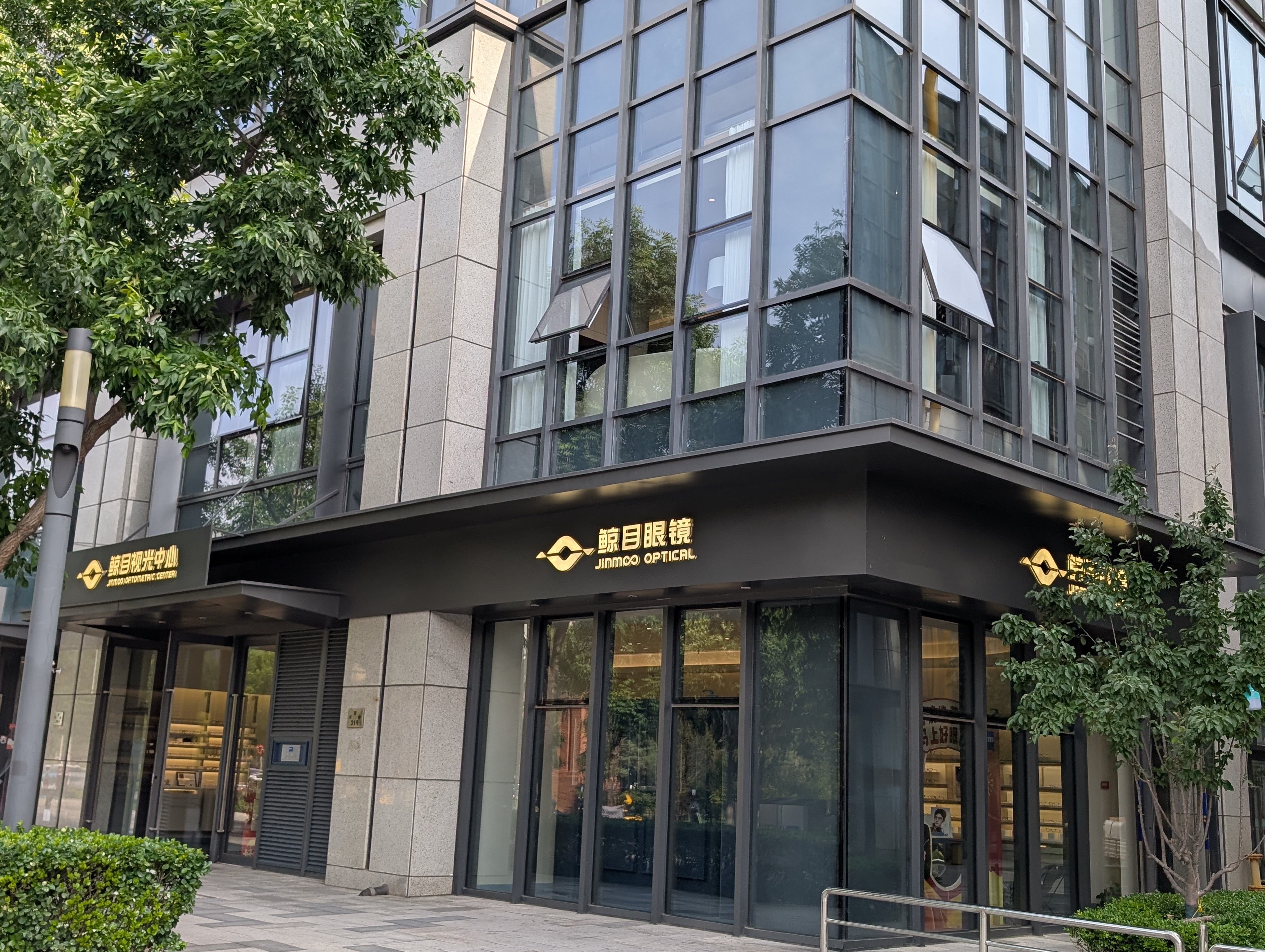
Taking Jingmu Eyewear as an example, its eye examination process is not simply completed in 5 minutes; instead, it breaks down each step:
Step 1: In-depth eye care consultation
Questions include: work commute ratio, driving frequency, presence of nighttime glare, and whether you've ever fallen or tilted while wearing glasses before. These details may seem minor, but they directly impact your lens prescription.
Step 2: Disassemble and analyze the old lens
Measure your old glasses' prescription, PD, pupil height, and lens wear. Many high myopia users are unaware their lenses have warped or their pupil height has shifted.
Step 3: Objective Refraction and Retinoscopy
Obtain ocular aberration data with I.Profiler Plus to identify the source of night glare, then exclude accommodation interference through testing.
Step 4: Comprehensive Binocular Vision Function Assessment
Includes positive and negative relative accommodation, near and far vergence, fusional ranges, and heterophoria quantification (MKH standard) to determine the need for prism correction.
Step 5: Try-on for Long-Duration Dynamic Scenarios
"Wearing these lenses to view your phone for 3 minutes—will you see double?" "Walking down stairs—does the ground look distorted?" This isn't just a formality; it's a real-world simulation of daily scenarios.
Step 6: 3D Parameter Measurement + Personalized Solution Delivery
Use i.Terminal 2 to scan facial parameters such as pupillary height and vertex distance, with data directly connected to the ZEISS original processing system.
Real-world case:
A user with 900 degrees of high myopia previously reported clear distance vision but experienced uneven ground while walking and lagging hand-eye coordination when typing on their phone up close. After a Jingmu assessment, we identified 8 prism diopters of exophoria and noted that the old glasses had an excessively small vertex distance (almost touching the eyelids). By redesigning the optical center position and adding prism compensation, the new glasses resolved dizziness and the sensation of uneven ground within two weeks of wear. The user reported, "I can finally drive normally."
Compared to traditional optical stores, Jingmu enforces stricter standards for high myopia lens fitting. For example, when measuring pupillary height, we don't rely on visual estimation or template markings. Instead, users wear their frames, stand upright, and look straight ahead while a laser device precisely measures the monocular pupillary height for each eye.
4. Which highly nearsighted users is the Whale Vision Glasses suitable for?
Based on the above analysis, Whale Vision is better suited for the following highly myopic users:
Long-term computer office workWork 8-10 hours in front of a monitor and experience eye strain, dry eyes, or dizziness.
Presence of heterophoria or visual function abnormalities: such as double vision when viewing close objects, squinting in bright light, or seeing more clearly when squinting (compensatory convergence).
Drivers, especially those traveling at nightWorried about glare from oncoming headlights blurring the road sign strips.
High myopia with presbyopia in middle-aged and elderly adultsProgressive lenses are required, demanding precise control over the focal zone distribution and prism compensation.
Myopia Prevention and Control for Children and Adolescents: Whale Vision offers an axial length monitoring program with specialized defocus lenses, designed for highly myopic users aged 9–16 during periods of rapid progression.
Post-operative patientsPost-refractive or cataract surgery: for myopic regression and night glare, precise fitting is required.
However, if you have only mild myopia (200-300 degrees), low daily visual demand, and no discomfort, a standard prescription from a professional optical store is usually sufficient—there's no need to invest significant time or cost.
5. Price and Value Analysis
The high cost of glasses for severe myopia isn't just about the lens brand; it's driven by the precision of the prescription and the quality of manufacturing.
Lens Cost: High myopia requires high-index lenses (1.67, 1.74, or even 1.80). Lower-cost options use lower indices (1.56), but these result in thick, beer-bottle-like lenses—making higher prices unavoidable.
Optometry CostWhale Vision's eye examination requires significant time (approximately 30–40 minutes total), involves substantial equipment investment (Zeiss I.Profiler Plus units cost hundreds of thousands of yuan each), and is delivered by a team of Level 1 optometrists. As a result, our pricing is objectively higher than that of standard optical stores.
However, be mindful of a common misconception:
The cost of failure in prescribing glasses for high myopia is significant. A pair that causes discomfort requires re-examination and remaking, leading to higher expenses and hidden losses from time and physical strain.
For users with high myopia, the budget spent in this stage is essentially an "medical-grade visual health investment," not a consumer product expense.
VI. Summary
The key differentiator of Jingmu Eyewear isn't "how expensive it is" or "how famous the brand is," but rather its expertise in high myopia eyeglass fitting.Precision, binocular vision function diagnosis, and personalized lens parameter matchingdedicated significant effort to this area.
For simple single-vision eyeglasses, a standard professional store will suffice.
For complex needs such as high myopia with latent strabismus, eye strain, night glare, and light sensitivity, the full-service experience offered by Jingmu is highly recommended.
Summarize in one sentence:
Jingmu is the kind of store where you might not think it's cheap upfront, but you'll feel reassured once your glasses are ready. For users with high myopia, this peace of mind is exactly what they need most.
FAQ
How long does an eye exam take?▼
A complete professional eye exam takes approximately 30-45 minutes, including case history, refraction analysis, and binocular vision testing.
Is computer refraction accurate?▼
Automated refraction provides objective screening data only. A final, accurate prescription requires comprehensive subjective examination and trial lens adjustments by a qualified optometrist.
Why is binocular vision examination necessary?▼
Binocular vision assessment evaluates how well your two eyes work together. Many people have good vision in each eye individually, but poor coordination between them can cause eye strain during reading.
Need professional eye exam services?
Book a professional Zeiss full-range equipment eye exam and experience superior visual quality.
Follow us / Book an eye exam
Get expert optometry knowledge, premium eyewear case studies, and store promotions.
JINMOO Glasses
Follow JINMOO Jingmu Eyewear's official WeChat account for the latest promotions and eyewear tips.
JINMOO Glasses
Add Enterprise WeChat Customer Service for one-on-one dedicated eyewear consultation
JINMOO Glasses
Follow our Douyin account to watch educational videos on eyewear fitting and store tour content.
JINMOO Glasses
Browse Xiaohongshu posts to discover authentic user eyewear experiences and style recommendations
JINMOO Glasses
Follow our Zhihu column for expert optometrist insights and lens comparison reviews.
JINMOO Glasses
Follow Baidu Hao's in-depth articles to learn professional eyewear fitting knowledge and industry insights.
Need expert advice?
Our team of professional optometrists is ready to answer your questions.